


1912 Knabe Grand
Updated: Jul 2
For a long time, I've had a few pianos listed for sale on my website, though they have all been in various stages of rebuilding and repair. With how busy life can move, it's hard to find time to fix pianos at home, especially when the business has been growing so rapidly! Last year I acquired another book of business, helped my mom prepare her house for sale, got married, and welcomed a new nephew into the world. While I've been very excited to work on my piano projects, they tend to move slowly around here.
However, in December of 2024, I decided

to get serious about my 6'4" Knabe grand. I knew I would be moving to Lebanon soon, and I wanted to get it finished so that I could sell it to make room in my new space. I began the process of my standard restoration work; rebushing keys and cleaning the piano. I had already shined all the brass hardware a while back, and I knew I wanted to replace the action parts, so I also measured the action and evaluated my options. Wessel, Nickel, and Gross (WNG) is a piano parts manufacturer best known for their carbon composite parts. I had always known about them but never had the opportunity to try using them in a project. The Knabe would be a perfect fit! Being from 1912, it was manufactured with the wisdom of its time, and that wisdom unfortunately hasn't held up over the years. The action was likely treated with various chemicals and oils, possibly mutton tallow (that's what Steinway used for their actions), which was never cleaned up. This leads to a buildup of gunk in the action center pins called verdigris (the green stuff), causing excess friction. This treatment was typically used as either a lubricant or as a measure to prevent humidity from affecting the wood in the action, though clearly the action stiffness wasn't expected. I figured that the best way to keep the idea of the manufacturer (action smoothness, humidity resistance) was to use the WNG carbon composite action rather than standard wood parts.
This Knabe would be a major undertaking: I would have to replace the hammer shanks and the repetitions, which make up the main body of the action. The hammers weren't original, replaced sometime in the past by another tech, but I decided to start fresh there too, so it would get new Abel hammers from Brooks Ltd., another piano supplier. Several key sticks would need to be repaired, as would the finish on the case of the piano. Finally, many major action felts would need to be replaced; of course, regulation and tuning at the end.
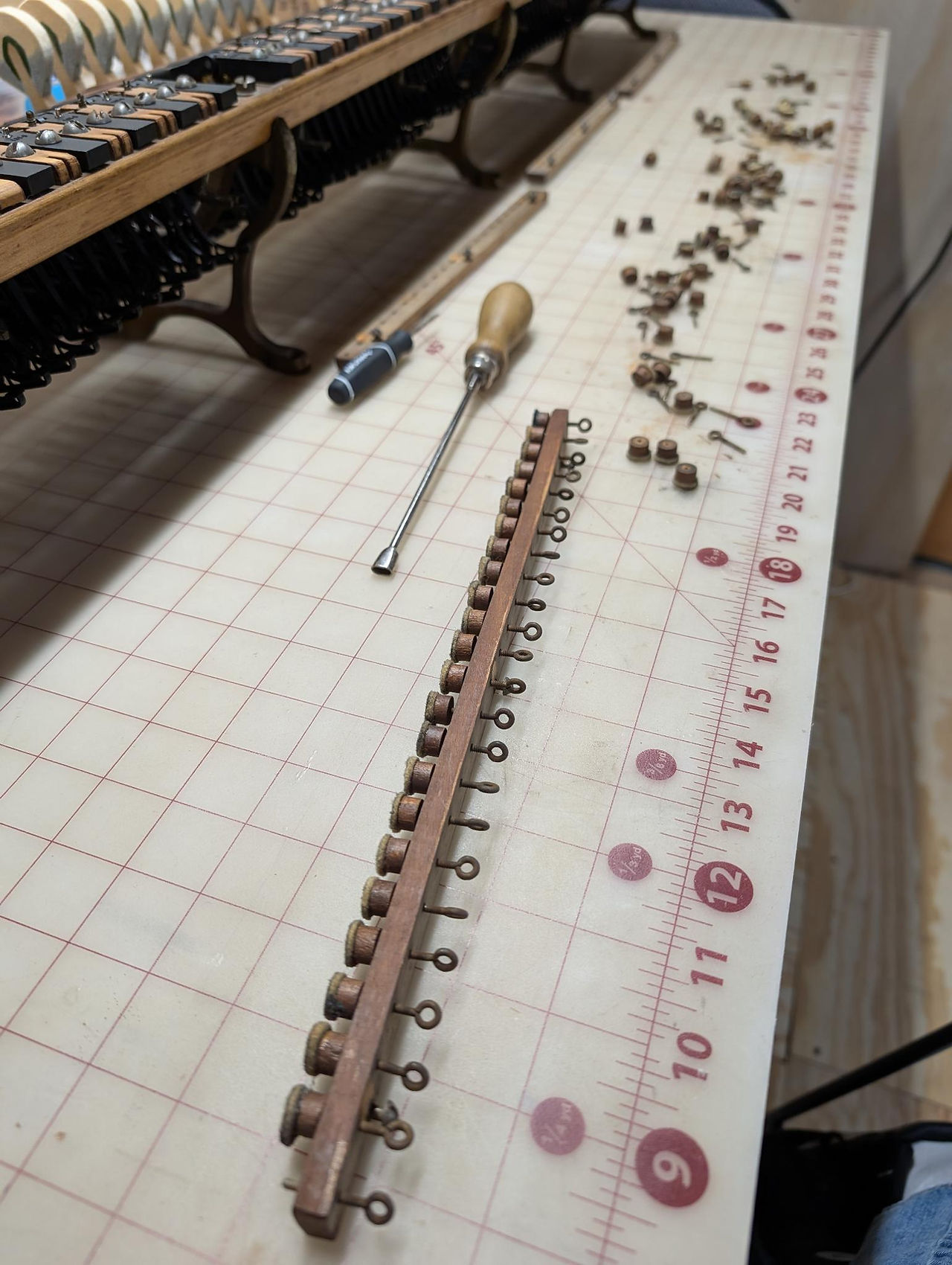

I began replacing the let-off buttons and screws in February of 2025, which is an easy enough job; remove the old screws and buttons from the rail, install new ones. I also replaced all the felt, which was pretty easy as well; finding the right sizes was challenging, though!


I shipped off the keys to a piano tech in Michigan who specializes in replacing keytops. I believe a previous tech had tried to replace the keytops on the Knabe using a heat gun, which burnt and destroyed a lot of the plastic, so I decided to start fresh there, too.
Replacing various felt in the action and on the key cover. A look at the carbon composite parts.
Removing the old action parts after measuring was quite fun, as was installing the new ones to check my work. I hit a snag here; I accidentally ordered the hammer shanks with the knuckles pre-installed. WNG knuckles have several different locations where they can be installed, and the Knabe needed them in a different spot than the ones I ordered were in. So, after returning those and getting a new set, I was good to go... except now it was time to move! In April, I packed up the Knabe and switched my focus to my antique Vose and Sons upright to prepare it for moving (gutting the internals for a future project!), and in May, I moved to Lebanon.
Rebushing and repairing mortises that had become worn. The keys could slide front to back, so I filled in the space.
I had seemingly endless housekeeping tasks to take care of, on top of tunings and working on the business merger, so the Knabe fell by the wayside. I was planning a family vacation, as well as trying to keep up with the massive growth I experience in the summer, when I got a text from an old friend who was looking to purchase a baby grand for a construction project in downtown Nashville. After showing him the Knabe, the designer decided she liked the look of the black satin, and they told me they wanted to buy it. Great! Only, it wasn't done yet. I still had a lot to do on it!
In this video, I removed the old repetitions to prepare for installation of the new ones.
And in this one, Molly and I install the new set.
I got in contact with Josh Ashby at Wingnut Building and Repair, who is a woodworking expert and had done some work for my wife's family. I asked if he could refinish a piano, and he said he was willing to try! Having seen his work in the past, I had faith in his abilities, so he got to work on something totally new for him. Unfortunately, I don't have great before and after pictures of what was repaired on the case. I needed not only the piano refinished, but also some parts filled in where the wood had chipped away, as well as a brand-new lid prop. A previous tech had sawn off 5" from the original lid prop, which caused it to connect at a dangerous angle. Lid props should make a 90-degree angle with the lid, so I bought a Baldwin lid prop and Josh sanded and painted it black to match. He would come over in the evenings and spend a few hours sanding, painting (yes, painting; the original finish was paint, not stain, and we chose to match that) and polishing, while I would be at the workbench tinkering with the keys to repair the mortises or working on sanding down various rails in the action to create clearance for the new parts. One quirk of the WNG parts, and really modern replacement parts generally, is that they have to be built to fit into an extremely wide variety of action types. Sometimes it'll be a perfect, easy fit, but that's more likely in the newer pianos that all had more similar designs. In an older piano, I may be able to get a repetition that is the right length and has the right flange size, but the way it's cut ends up being different from the original, so the only way to fit it in is to remove material. This is just a small example. After setting the correct knuckle and heel placement, getting all the repetitions in, it was time to work on the hammer shanks.
These ended up being tricky because the last tech who replaced the hammers may have made a mistake in the placement, so I had to double check the optimal placements. I couldn't just match the originals! I made more than a few mistakes and had to reglue some hammers, and cutting the shanks with a Dremel tool turned out to be quite messy. With my wife (then fiancée) occasionally helping out, we were able to make some steady progress as the piano cabinet was looking better and better.
The action put together; we forgot to take as many pictures towards the end. I had to do a little extra work to the action after the piano was delivered in December.

We got closer to the wedding and honeymoon in October, which was lovely. Josh continued to work while we were gone, and after we got back, I had a ton of regular tunings to catch up on. November approached, and the due date for the Knabe delivery got pushed back. This actually happened a few times until the date was firmly set on December 15th; various things in our schedules kept popping up that kept the delivery from happening. That worked out for us, because we had a new problem; regulating a WNG action is a little different from a regular wood action, and it was made more difficult by the fact that this was a rebuilding job. Fortunately, Josh had finished at this point. We ran into several problems and ended up having some VERY late nights. One weekend, Molly and I worked a combined ~50 hours trying to diagnose, find the right sized parts, and regulate this piano properly. Finally, the 15th rolled around, so I tuned it one final time, and it was off! It's A Piano, Inc., did the move for me, and I followed them to Nashville to see it in its new home.

This was a stressful project, but I learned a lot from it, both about piano rebuilding but also about time and business management. Molly and I have been VERY happy about having a dining table in our home in place of a 6'4" grand piano, and business has slowed down to a more comfortable pace in the last few months. I've begun work on another antique piano, this time a 1904 Mason and Hamlin upright, which I hope to finish this year. Hopefully I can also work more on writing these blog posts, which I really do enjoy. I look forward to sharing the next project!


Comments